"Winds of the Anasazi©"
Lyrics by M. S. McKenzie (Unless Otherwise Noted) | Music Performed by Songs Across America or American Storyteller Music, All Songs Are Protected by Copyright


~ Associated Colorado State Links ~
I wrote "Winds of the Anasazi" as a tribute to the Ancestral Puebloan people who built entire communities into Colorado's canyon walls and then, when the land could no longer support them, left with a discipline I find remarkable. They read the land like a sacred text, but left the land when the blight came, and I wanted the song to honor that wisdom, knowing when to go, as much as the incredible architecture they left behind.
The story behind the song is how much daily life I let survive in the verses, children playing in walled courtyards, mothers and daughters shaping pots from clay, fathers weaving reed, fire-lit kivas where songs were sung to the stars. I did not want this to be only a song about ruins. I wanted it to be a song about the actual people who lived complete, connected lives in those cliff dwellings long before anyone called them ruins at all.
What I care about most is the bridge's claim, the winds remember everything, the names, the songs, the prayers, because I wanted the wind itself to function as the last living witness to a culture that otherwise left mostly silence behind. Songs Across America has room for the deep history carved into this country's landscape, and few places carry that history as visibly as these canyon walls.
Haunting, atmospheric folk built on layered vocals and a reverent, echoing chorus, structured as a walk through the cliff dwellings and daily life of the Ancestral Puebloan people.
Ancestral Puebloan history and daily life, harmony with the land as a discipline rather than an accident, memory carried by wind and stone, and reverence for a culture's wisdom in knowing when to leave.
Primary Subject:
The Ancestral Puebloan (Anasazi) people of Colorado's mesa country, their cliff dwellings, farming, and the wisdom of their eventual departure.
Mood:
Haunting, reverent, and deeply respectful throughout.
A culture that built itself into a canyon wall and then, in wisdom, chose to leave rather than exhaust the land, deserves to be remembered as a complete and connected way of life, not merely as ruins left behind.
"Winds of the Anasazi"
[Intro]
Winds of the Anasazi drift through and over the stones
Through silent homes of sandstone, carved and overgrown
The echo of their footfalls lingers there, among the ruins
With walls of baked clay, built high above a river confluence
[Verse 1]
They farmed the mesa’s tableland beneath the sacred mountain's sight
Planting corn, squash and beans, they foraged plants and hunted game
They gathered up what nature provided, waiting for when the time was right
They read the land like a sacred text, but left the land when the blight came
[Chorus – Layered Vocals]
The winds of the Anasazi still whisper through piñon pines
Whispering ancient stories in the silence they left behind
Where the snow-capped mountains rise and golden eagles glide
Their haunting spirits still remain upon every mesa's side
[Verse 2]
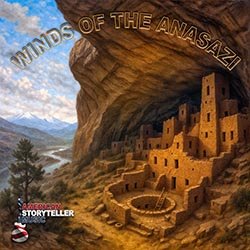
They built their homes in cliff overhangs and made scores of little jars
They built ladders made of cedar wood that reached up to every room
In fire-lit kivas they built underground, they sang their songs to the stars
The breath of their spirits rise up and echoes the silent tales of their doom
[Verse 3]
The children played in walled courtyards, beneath the eagle’s flight
Their laughter echoing through time, vague expressions in the sunlight
Mothers and daughters shaped pots from clay while fathers wove the reed
Together they all lived in nature's harmony, sustained for their every need
[Bridge]
The winds remember everything:the names, the songs, the prayers
It speaks in hushed and hallowed tones through the dry and dusty air
If you listen above the canyon rim, hold the breath within your chest
I swear you’ll feel their humble presence rising still, from centuries of rest
[Verse 4]
Now excited tourists walk these narrow paths where elders once trod
They speak in a hundred different tongues, but still feel something odd
Whispers heard in dark recesses, or the feel of a hand as a shadow passes near
Leaves you with the sense that those who lived here once may still be near
[Instrumental Outro]
"Winds of the Anasazi" is a haunting Southwestern folk-rock ballad about memory, ancestral presence, and the lives once lived within the cliff dwellings, mesa-top villages, and canyon communities of the American Southwest. Through images of sandstone homes, cultivated fields, cedar ladders, fire-lit kivas, pottery, children's laughter, and winds moving through abandoned rooms, the song imagines the ruins not as lifeless archaeological remains but as places still resonating with human experience.
The song's central idea is that a community may leave a place without being entirely erased from it. Footsteps disappear, fires go cold, and homes fall silent, yet evidence of daily life remains embedded in walls, pathways, pottery fragments, cultivated ground, and oral tradition. The wind becomes the carrier of those memories, moving through the same spaces once occupied by families and transforming silence into something that feels almost like a voice.
The title is atmospheric and immediately evocative. "Winds of the Anasazi" suggests that the people's presence survives in an invisible form, drifting through canyon country and moving among the ruins. The wind cannot be seen or held, yet its effects are unmistakable. It stirs piñon branches, passes through doorways, lifts dust from courtyards, and creates tones within narrow stone passages.
Symbolically, the wind represents memory itself. We cannot fully recover the names, conversations, emotions, and private experiences of people who lived centuries ago, but traces of their world remain. Like wind, the past is invisible while still exerting pressure upon the present.
Although "Anasazi" has long been widely used in archaeology and popular culture, "Ancestral Pueblo people" is now generally preferred. The older term came through a Navajo word and can carry meanings that some Pueblo people consider inappropriate. More importantly, "Ancestral Pueblo" emphasizes continuity: these were not a mysterious vanished race but ancestors of living Pueblo communities. Within the song, that understanding makes the wind less like the voice of a lost civilization and more like a connection between earlier generations and their descendants.
The introduction establishes the song's mournful, suspended atmosphere. The wind moves over stone and through "silent homes of sandstone," immediately placing the listener within a settlement that was once active but is now still.
The word "homes" is important. These structures were not created merely as monuments or mysterious ceremonial ruins. They were living spaces where people prepared food, stored crops, raised children, made tools, repaired clothing, formed relationships, and responded to changing seasons.
The sandstone structures are described as carved and overgrown, suggesting both careful human construction and the slow return of natural processes. Plants take root around walls, sediment gathers in rooms, and weather gradually softens built forms back into the surrounding canyon.
The echo of footfalls lingering among the ruins introduces the song's principal imaginative device. No literal footsteps remain, yet walking through these places can create a strong awareness that countless others traveled the same passages. The modern visitor's steps seem to awaken the memory of older ones.
The "walls of baked clay" convey the earth-toned appearance of Pueblo architecture, although many ancestral dwellings were built using shaped sandstone blocks, mortar, plaster, adobe, or locally available volcanic materials depending upon the region. At Mesa Verde, for example, homes were constructed within sandstone alcoves, while Bandelier communities used masonry and rooms carved into volcanic tuff.
The reference to a river confluence gives the settlement a strategic and symbolic setting. River junctions offered water, travel corridors, fertile ground, wildlife habitat, and connections among communities. In the song, the confluence also becomes a metaphor for the meeting of human history and the natural landscape.
The first verse turns from architecture toward subsistence and environmental knowledge. The people farm mesa-top land beneath a sacred mountain, planting corn, beans, and squash while also gathering wild plants and hunting game.
These details ground the song in the practical work required for life in an arid environment. Ancestral Pueblo communities relied heavily upon cultivated foods, particularly corn, beans, and squash, while supplementing agriculture with gathered plants and hunted animals. Their farming methods were adapted to limited and unpredictable rainfall.
The "mesa's tableland" creates a broad visual image of elevated, relatively level ground above the canyons. These mesa tops could support fields exposed to sunlight and seasonal moisture, even when homes were constructed below within protected alcoves.
The sacred mountain watching over the fields introduces the cultural relationship between geography and spirituality. Mountains were not merely distant landmarks. They could help orient communities within a larger homeland and carry ceremonial, ancestral, and directional meaning.
The crops themselves represent cooperation and foresight. Planting requires confidence in the future. Seeds are placed into dry soil with the hope that rain will come, plants will mature, and enough food can be stored for the coming winter.
The song also recognizes that farming was only one part of survival. People foraged for useful plants, gathered nuts and seeds, hunted animals, and carefully used whatever the environment provided.
"They gathered up what nature provided, waiting for when the time was right" conveys patience and seasonal knowledge. Survival depended upon knowing when plants ripened, when animals moved, when storms might arrive, and when fields should be planted or harvested.
"They read the land like a sacred text" is one of the song's strongest lines. It presents the environment as something to be interpreted with attention and respect. Clouds, soil, plants, snow, springs, animal behavior, and wind could all convey information necessary for survival.
The comparison also suggests that knowledge of the land was both practical and meaningful. Reading the landscape involved accumulated observation passed across generations rather than casual intuition.
The final line says that they left when "the blight came." This creates a concise dramatic explanation, but the actual migrations of Ancestral Pueblo communities were complex. Drought, crop stress, social change, conflict, shifting trade relationships, and spiritual or political factors may all have contributed differently across places and periods. The communities did not simply vanish; they migrated and established lives elsewhere, and many present-day Pueblo communities trace their ancestry to these regions.
Within the song, "blight" may therefore be understood broadly as environmental and social hardship rather than a single crop disease. It represents the moment when the existing way of life could no longer be sustained in the same place.
The first chorus opens the landscape outward through piñon pines, snow-covered mountains, golden eagles, and mesa slopes. The wind becomes a layered vocal presence, whispering the stories left within the silence.
Piñon pines are especially appropriate because they are closely associated with the high desert and upland Southwest. Their nuts were an important source of food, while their wood, shade, and presence contributed to daily life.
The repeated word "whisper" creates intimacy. The past is not shouting for attention or presenting a complete explanation. Its voice is fragmented, subtle, and dependent upon a listener willing to become quiet.
"Ancient stories in the silence they left behind" captures the emotional paradox of archaeological places. Their silence can feel full rather than empty because every room and wall suggests activities that can no longer be heard directly.
The snowcapped mountains and gliding eagles elevate the chorus above the enclosed dwellings. Human life once unfolded within a much larger system of weather, wildlife, elevation, water, and seasonal movement.
The line "Their haunting spirits still remain upon every mesa's side" gives the song its supernatural atmosphere. This can be understood poetically rather than literally. The "spirits" are the emotional and cultural presence created by architecture, ancestral connection, story, and landscape.
The word "haunting" does not necessarily imply terror. It suggests something unforgettable that continues returning to thought. The ruins haunt the visitor because they make vanished moments of ordinary life feel unusually close.
The second verse turns toward architectural and ceremonial details. Homes occupy cliff overhangs, jars are made for carrying and storing materials, cedar ladders connect different levels, and kivas glow with firelight.
The cliff dwellings were among the last major structures built by Ancestral Pueblo communities in the Mesa Verde region. Some included dozens or even more than one hundred rooms, along with kivas that served important community and ceremonial functions.
The cliff overhangs offered shelter while also creating architectural challenges. Rooms were fitted into natural alcoves, sometimes rising several stories and requiring ladders for movement between terraces or openings.
The "scores of little jars" bring the verse down to the scale of household life. Pottery was essential for cooking, serving, transporting, and storing water and food. Its forms, painted designs, fingerprints, wear, and breakage preserve evidence of individual makers and everyday use.
The cedar ladders create a striking vertical image. They connect lower courtyards to rooms, storage spaces, and higher ledges. In musical terms, the upward movement of the ladders could be reflected by a rising melodic phrase.
The kivas introduce the communal and ceremonial center of the settlement. These structures were typically circular or subterranean and are understood as important gathering and ceremonial spaces.
The image of songs rising from a fire-lit kiva toward the stars beautifully joins the enclosed underground room with the open universe above it. The people gather below the earth while their voices reach toward the sky.
The line "The breath of their spirits rise up" would read grammatically as "The breath of their spirits rises up." A more lyrical variation might be:
"The breath of ancient spirits rises
And echoes stories through the gloom."
The reference to "their doom" gives the verse a tragic and fatalistic tone. Historically and culturally, however, it may unintentionally imply total destruction or extinction. Since their descendants remain part of living Pueblo communities, "migration," "departure," "change," or "journey" would express the historical transition more accurately.
A possible revision would be:
"The breath of their spirits rises up
And echoes stories through each room."
This preserves the haunting atmosphere without suggesting that the people were entirely destroyed.
The third verse is one of the song's most humanizing passages. It imagines children playing in courtyards, mothers and daughters shaping pottery, and fathers weaving reeds.
These scenes move beyond monumental architecture and remind the listener that entire families lived within these communities. The dwellings were filled not only with formal ceremonies but with work, humor, frustration, teaching, play, meals, and ordinary relationships.
The children's laughter echoing through time is an especially powerful image. Archaeological sites can easily be imagined as solemn places because visitors encounter them in silence, but they would once have been filled with voices, crying infants, games, conversations, tools, animals, and movement.
The phrase "vague expressions in the sunlight" creates the impression of faces that cannot be fully recovered. The narrator can imagine the children but cannot know their individual names, personalities, or thoughts.
Pottery making becomes an intergenerational activity. Clay is gathered, prepared, shaped, smoothed, painted, and fired through methods learned and refined over time. The lyric suggests knowledge passing through families.
The line about fathers weaving reed may refer broadly to the making of baskets, mats, sandals, cordage, or other plant-fiber objects. The division of labor presented in the lyric is poetic rather than a definitive statement about who performed each task, since roles likely varied across communities, households, and periods.
"Together they all lived in nature's harmony" idealizes the past somewhat, but its purpose is clear. The people depended directly upon the land and possessed highly developed knowledge of its limits and possibilities.
Harmony should not be understood as a life without struggle. Farming in an arid region involved drought, hunger, labor, injury, conflict, and uncertainty. The harmony described in the song comes from adaptation and close attention rather than an effortless existence.
The line "sustained for their every need" conveys reliance upon the regional environment, though these communities also participated in extensive trade networks and exchanged materials, ideas, and goods over long distances.
The bridge gives the wind a nearly conscious memory. It remembers names, songs, and prayers that modern visitors cannot recover.
"The winds remember everything" is the song's central poetic declaration. Stone may preserve material evidence, but the wind symbolically preserves the intimate and immaterial parts of life: spoken names, melodies, blessings, grief, affection, and private conversation.
The punctuation in "The winds remember everything:the names" would be clearer with a space after the colon:
"The winds remember everything: the names, the songs, the prayers."
The shift from plural "winds" to singular "It speaks" would also read more smoothly as "They speak" or by changing the first phrase to "The wind remembers everything."
"Hushed and hallowed tones" gives the wind a reverent voice. The dry air becomes almost ceremonial as it passes through rooms and across canyon rims.
The listener is asked to stand above the canyon, hold a breath, and become still. This physical instruction draws the audience into the experience. Silence is not merely described; it is requested.
Holding one's breath heightens hearing and awareness. Small sounds become more noticeable: a bird's wing, loose sand, branches, distant water, or air passing through an opening.
"I swear you'll feel their humble presence rising still" is intentionally subjective. The narrator does not present proof of a supernatural occurrence. He describes the emotional sensation that can arise in a place marked by ancestral life.
The phrase "centuries of rest" once again risks suggesting that the culture ended completely. Within the song's poetic frame, it works best when understood as referring to the silent buildings rather than to Pueblo peoples as a whole.
The fourth verse introduces modern tourism and creates a striking contrast with the earlier scenes. Visitors now follow narrow pathways once used by residents and elders, speaking many languages while trying to understand a world separated from them by centuries.
The word "excited" captures the energy of tourism but also hints at discomfort. Visitors may arrive eager for photographs and novelty, while walking through places that retain deep cultural significance for descendant communities.
The contrast is not necessarily condemnatory. People from across the world can feel moved by these sites and learn from them. The song suggests that the ruins possess an emotional force capable of crossing language and nationality.
"They still feel something odd" introduces the paranormal tone more directly. The unusual feeling may arise from darkness, acoustics, confined spaces, altitude, imagination, cultural memory, or genuine reverence.
Whispers in recesses and the sensation of a passing hand create classic ghost-story imagery. The song deliberately leaves the experience unexplained.
These moments may be understood literally by listeners who believe in spiritual presence, or metaphorically as the mind responding to spaces saturated with human history. The ambiguity strengthens the song because it does not require a single interpretation.
The final line leaves the listener with the sense that the former residents remain near. The word "may" is crucial. It preserves mystery rather than making a factual declaration.
More broadly, their presence unquestionably does remain through architecture, objects, descendant communities, cultural tradition, and the continuing significance of ancestral places. The song's spiritual imagery gives emotional form to that continuity.
Musically, "Winds of the Anasazi" would work especially well as atmospheric Southwestern folk-rock, cinematic Americana, or a slow historical ballad. The arrangement should feel reverent, spacious, and slightly mysterious rather than frightening.
The introduction could begin with wind ambience, low wooden flute, fingerpicked acoustic guitar, and a distant frame drum. Any Indigenous-associated instrumentation should be used carefully and without attempting to imitate a specific Pueblo ceremonial song.
Low strings or sustained electric guitar could enter beneath the images of sandstone homes and river confluence. The music should create the feeling of approaching the ruins at dusk or dawn.
The first verse could remain sparse and rhythmically steady, reflecting planting, gathering, and the patient work of reading the land. Hand percussion, acoustic guitar, and a warm bass line could provide movement without disrupting the contemplative atmosphere.
The chorus should broaden through layered voices, as indicated in the lyrics. These voices could repeat or sustain "the winds" and "still whisper," creating the impression of sound moving from multiple directions across the canyon.
The harmonies should feel distant and airy rather than heavily choral. Reverb and stereo placement could make individual vocal lines appear like echoes returning from separate cliff walls.
The second verse could introduce darker instrumental tones around the cliff dwellings and kivas. Cello, low drum, and subtle vocal humming might evoke the enclosed warmth of ceremonial space without reproducing sacred musical traditions.
The image of songs rising toward the stars offers an opportunity for the melody to climb gradually into a higher register.
The third verse should become warmer and more human. Acoustic strings, gentle violin, or soft piano could accompany the children, families, pottery, and courtyard scenes. This section should make the settlement feel alive before the bridge returns to the present-day silence.
The bridge should reduce the arrangement dramatically. A nearly unaccompanied vocal over wind, low drone, or a single guitar figure would allow "The winds remember everything" to become the emotional center.
The music could begin building under "hold the breath within your chest," then briefly fall silent before the narrator says that the ancestral presence can still be felt.
The fourth verse might introduce a light pulse representing modern footsteps along the trail. Echo effects, muted strings, and occasional whispered backing vocals could reinforce the uneasy feeling within the recesses.
The instrumental outro should avoid a dramatic resolution. A flute, violin, or clean electric guitar could restate the chorus melody while wind gradually overtakes the other instruments.
The final sound might be air passing across stone, leaving the story open and suggesting that the wind continues long after the visitor has departed.
At its heart, "Winds of the Anasazi" is a song about the limits of historical knowledge and the endurance of human presence. We can study architecture, farming, pottery, migration, and ceremonial structures, but we cannot fully recover the private emotional worlds of the people who lived there.
The song fills that silence through imagination. It hears children in courtyards, songs within kivas, footsteps on ladders, and prayers carried through desert air. These imagined details restore human warmth to places too easily reduced to ruins.
Its greatest strength is the movement between daily life and mystery. Cornfields, pots, ladders, and woven reeds make the people tangible, while wind, echoes, and unseen touches preserve a sense of wonder.
The song also carries an implicit conservation message. These sites are not empty backdrops for adventure. They are culturally meaningful ancestral places that deserve careful protection, respectful visitation, and interpretation informed by descendant communities.
"Winds of the Anasazi" is therefore both a historical landscape song and a meditation on remembrance. It asks what remains when a community migrates, buildings fall silent, and centuries pass.
The answer is not merely stone. Knowledge remains. Descendants remain. Stories remain. The impression of countless lives remains.
Its deepest message is that absence does not always mean disappearance. The voices of the past may no longer be heard directly, but their influence still moves through the Southwest like wind through piñon branches: invisible, persistent, and waiting for someone willing to become quiet enough to listen.


















.jpg)
